
Cycling Spatial Derivative Strategy for DEGP#
This tutorial demonstrates a spatially-aware derivative assignment strategy for Derivative-Enhanced Gaussian Processes (DEGPs). Instead of providing all derivatives at every training point, we assign exactly one derivative per point, cycling through dimensions along a spatial chain.
This approach is useful for:
Reducing computational cost in high-dimensional problems.
Exploring trade-offs between derivative coverage and model accuracy.
Understanding how GP correlation structure propagates derivative information.
Motivation#
In high-dimensional problems, providing full derivative information at every training point can be computationally expensive. The covariance matrix size scales with the total number of observations, so reducing derivative observations can significantly improve training time and memory usage.
Key insight: Gaussian Processes have a correlation structure that allows nearby points to share information. If neighboring points have complementary derivative information, the GP may be able to “fill in” the missing derivatives through spatial correlation.
The Strategy#
The cycling derivative strategy works as follows:
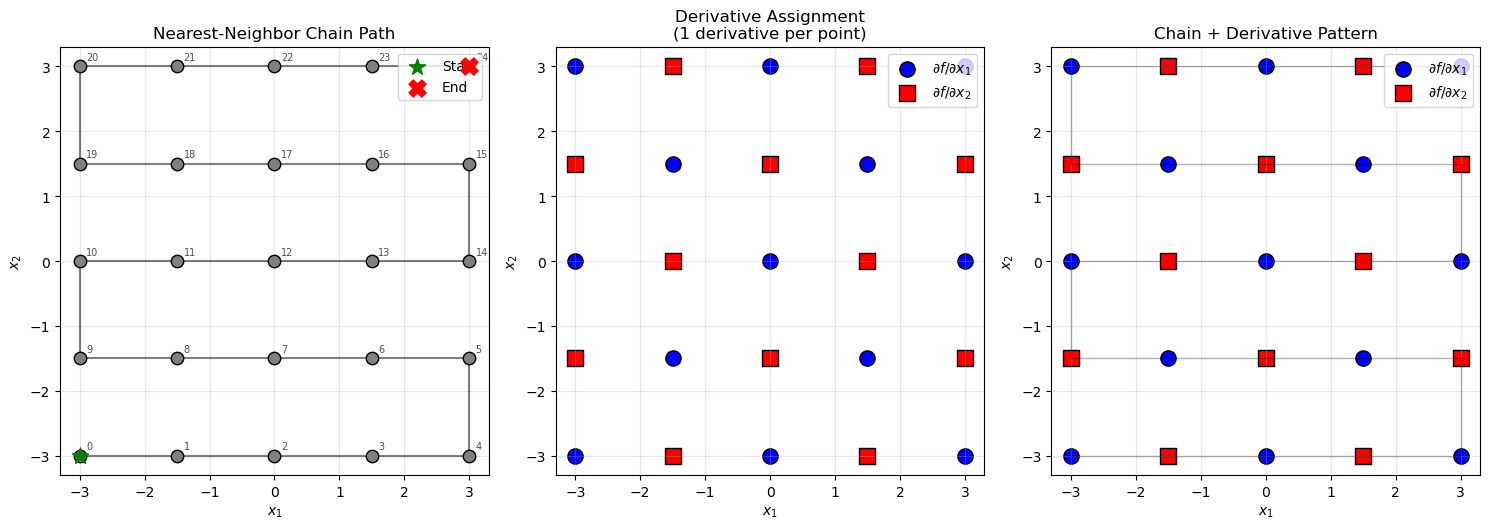
Build a spatial chain: Connect training points via a nearest-neighbor path
Cycle derivatives along the chain: Assign derivatives in a repeating pattern
For a 2D problem:
Position 0, 2, 4, … → ∂f/∂x₁
Position 1, 3, 5, … → ∂f/∂x₂
This ensures that adjacent points in the chain have different derivative information, maximizing the complementary coverage.
Setup#
We begin by importing all necessary libraries, including pyoti for hypercomplex
AD, full_degp for DEGP modeling, and standard scientific Python packages.
import numpy as np
import pyoti.sparse as oti
from jetgp.full_degp.degp import degp
import jetgp.utils as utils
from matplotlib import pyplot as plt
Configuration#
We explicitly define all configuration parameters as simple variables. This includes the dimensionality of the input space, grid size, kernel type, and other hyperparameters.
n_bases = 2
n_order = 1  # First-order derivatives only
grid_size = 5  # 5x5 grid = 25 points
test_resolution = 20
lower_bounds = [-3.0, -3.0]
upper_bounds = [3.0, 3.0]
normalize_data = True
kernel = "SE"
kernel_type = "anisotropic"
random_seed = 42
np.random.seed(random_seed)
True Function#
We use a 2D function with interesting structure that benefits from derivative information:
def true_function(X, alg=np):
    """
    2D test function:
    f(x1, x2) = sin(x1) * cos(x2) + 0.5 * x1 * x2
    """
    x1, x2 = X[:, 0], X[:, 1]
    return alg.sin(x1) * alg.cos(x2) + 0.5 * x1 * x2
Spatial Chain Construction#
The spatial chain connects training points via a greedy nearest-neighbor traversal. Starting from point 0, we iteratively add the nearest unvisited point to form a connected chain that traverses the space smoothly.
def build_spatial_chain(X_train):
    """
    Build a greedy nearest-neighbor chain through all training points.
    """
    n_pts = len(X_train)
    visited = [False] * n_pts
    chain = [0]
    visited[0] = True

    for _ in range(n_pts - 1):
        current = chain[-1]
        dists = np.linalg.norm(X_train - X_train[current], axis=1)
        dists[visited] = np.inf
        nearest = np.argmin(dists)
        chain.append(nearest)
        visited[nearest] = True

    return chain
Derivative Assignment#
Derivatives are assigned by cycling through dimensions based on chain position. Each point receives exactly one derivative observation.
def assign_cycling_derivatives(chain, n_bases=2):
    """
    Assign derivatives cycling through dimensions along the chain.

    For 2D:
    - position 0, 2, 4, ... -> d/dx1
    - position 1, 3, 5, ... -> d/dx2
    """
    derivative_groups = [[] for _ in range(n_bases)]

    for pos, pt_idx in enumerate(chain):
        group = pos % n_bases
        derivative_groups[group].append(pt_idx)

    return derivative_groups
Training Data Generation#
We generate training points on a regular grid and evaluate the function with derivatives using automatic differentiation.
def generate_grid_points(grid_size, lower_bounds, upper_bounds):
    """Generate training points on a regular grid."""
    x1 = np.linspace(lower_bounds[0], upper_bounds[0], grid_size)
    x2 = np.linspace(lower_bounds[1], upper_bounds[1], grid_size)
    X1_grid, X2_grid = np.meshgrid(x1, x2)
    X_train = np.column_stack([X1_grid.ravel(), X2_grid.ravel()])
    return X_train


def evaluate_function_with_derivatives(X_train, n_bases, n_order):
    """Evaluate function and all first-order derivatives at training points."""
    X_train_pert = oti.array(X_train)
    for i in range(n_bases):
        X_train_pert[:, i] += oti.e(i + 1, order=n_order)

    y_train_hc = true_function(X_train_pert, alg=oti)

    y_values = y_train_hc.real
    all_derivatives = {}
    for i in range(n_bases):
        all_derivatives[i + 1] = y_train_hc.get_deriv([[i + 1, 1]])

    return y_values, all_derivatives
DEGP Setup Functions#
We define two setup functions: one for the cycling strategy (1 derivative per point) and one for the full strategy (all derivatives at all points) as a baseline.
Cycling Strategy#
def setup_cycling_degp(X_train, y_values, all_derivatives, derivative_groups):
    """
    Set up DEGP with cycling derivative assignment.
    Each point contributes exactly one derivative observation.
    """
    # Function values at all points
    y_train_list = [y_values.reshape(-1, 1)]

    # Each derivative only at its assigned points
    for i, group_pts in enumerate(derivative_groups):
        var_idx = i + 1
        y_train_list.append(all_derivatives[var_idx][group_pts].reshape(-1, 1))

    # Derivative indices for first-order derivatives
    der_indices = [
        [[[1, 1]], [[2, 1]]]
    ]

    # Specify which points have which derivatives
    derivative_locations = [list(group) for group in derivative_groups]

    return y_train_list, der_indices, derivative_locations
Full Strategy (Baseline)#
def setup_full_degp(X_train, y_values, all_derivatives):
    """
    Set up DEGP with full derivatives at all points (baseline).
    """
    n_pts = len(X_train)
    all_points = list(range(n_pts))

    y_train_list = [y_values.reshape(-1, 1)]
    for i in range(1, 3):
        y_train_list.append(all_derivatives[i].reshape(-1, 1))

    der_indices = [
        [[[1, 1]], [[2, 1]]]
    ]

    derivative_locations = [all_points, all_points]

    return y_train_list, der_indices, derivative_locations
Model Training#
We initialize the DEGP model and optimize its hyperparameters using PSO
optimization. The model incorporates both function values and selected
derivatives, with derivative_locations specifying where each derivative
is available.
def train_model(X_train, y_train_list, n_order, n_bases, der_indices,
                derivative_locations, normalize_data, kernel, kernel_type):
    """Train DEGP model with PSO optimization."""
    gp_model = degp(
        X_train, y_train_list, n_order, n_bases,
        der_indices,
        derivative_locations=derivative_locations,
        normalize=normalize_data,
        kernel=kernel, kernel_type=kernel_type
    )

    params = gp_model.optimize_hyperparameters(
        optimizer='pso',
        pop_size=200,
        n_generations=30,
        local_opt_every=10,
        debug=True
    )

    return gp_model, params
Interpolation Verification#
We verify that the model correctly interpolates training data, checking both function values and derivative values at their specified locations.
def verify_interpolation(gp_model, params, X_train, y_train_list,
                         derivative_locations, model_name="Model"):
    """Verify that the model correctly interpolates training data."""
    print(f"\nInterpolation Verification for {model_name}")
    print("-" * 50)

    y_pred, _ = gp_model.predict(X_train, params, calc_cov=True, return_deriv=True)

    all_passed = True

    # Check function values
    y_func_true = y_train_list[0].flatten()
    y_func_pred = y_pred[0, :].flatten()
    func_error = np.abs(y_func_pred - y_func_true)
    func_max_err = np.max(func_error)
    func_pass = func_max_err < 1e-4
    all_passed = all_passed and func_pass

    status = "✓" if func_pass else "✗"
    print(f"{status} Function values:  max_err = {func_max_err:.2e}")

    # Check derivatives
    derivative_names = ["∂f/∂x₁", "∂f/∂x₂"]

    for i, (deriv_locs, name) in enumerate(zip(derivative_locations, derivative_names)):
        y_deriv_true = y_train_list[i + 1].flatten()
        y_deriv_pred = y_pred[i + 1, :].flatten()[deriv_locs]

        deriv_error = np.abs(y_deriv_pred - y_deriv_true)
        deriv_max_err = np.max(deriv_error)
        deriv_pass = deriv_max_err < 1e-4
        all_passed = all_passed and deriv_pass

        status = "✓" if deriv_pass else "✗"
        print(f"{status} {name} (n={len(deriv_locs):2d}): max_err = {deriv_max_err:.2e}")

    print("-" * 50)
    print(f"{'✓ ALL PASSED' if all_passed else '✗ SOME FAILED'}")

    return all_passed
Evaluation#
We evaluate the model on a fine grid to assess prediction quality.
def evaluate_on_grid(gp_model, params, lower_bounds, upper_bounds, resolution):
    """Evaluate model on a fine grid."""
    x1 = np.linspace(lower_bounds[0], upper_bounds[0], resolution)
    x2 = np.linspace(lower_bounds[1], upper_bounds[1], resolution)
    X1_grid, X2_grid = np.meshgrid(x1, x2)
    X_test = np.column_stack([X1_grid.ravel(), X2_grid.ravel()])

    y_pred, y_var = gp_model.predict(X_test, params, calc_cov=True)
    y_true = true_function(X_test, alg=np)

    return {
        "X1_grid": X1_grid,
        "X2_grid": X2_grid,
        "y_true": y_true.reshape(X1_grid.shape),
        "y_pred": y_pred.reshape(X1_grid.shape),
        "y_var": y_var.reshape(X1_grid.shape),
        "nrmse": utils.nrmse(y_true, y_pred)
    }
Visualization#
We create visualizations to understand the derivative assignment pattern and compare model performance.
Derivative Assignment Visualization#
def visualize_derivative_assignment(X_train, chain, derivative_groups):
    """Visualize the chain and derivative assignments on the 2D grid."""
    fig, axes = plt.subplots(1, 3, figsize=(15, 5))

    colors = ['blue', 'red']
    markers = ['o', 's']
    labels = [r'$\partial f/\partial x_1$', r'$\partial f/\partial x_2$']

    # Panel 1: Chain path
    ax = axes[0]
    chain_coords = X_train[chain]
    ax.plot(chain_coords[:, 0], chain_coords[:, 1], 'k-', alpha=0.5, linewidth=1.5)
    ax.scatter(X_train[:, 0], X_train[:, 1], c='gray', s=80, edgecolor='k', zorder=5)
    ax.scatter(*X_train[chain[0]], c='green', s=150, marker='*', zorder=10, label='Start')
    ax.scatter(*X_train[chain[-1]], c='red', s=150, marker='X', zorder=10, label='End')
    for i, idx in enumerate(chain):
        ax.annotate(str(i), X_train[idx] + np.array([0.1, 0.1]), fontsize=7, alpha=0.7)
    ax.set_xlabel('$x_1$')
    ax.set_ylabel('$x_2$')
    ax.set_title('Nearest-Neighbor Chain Path')
    ax.legend(loc='upper right')
    ax.set_aspect('equal')
    ax.grid(True, alpha=0.3)

    # Panel 2: Derivative assignments
    ax = axes[1]
    for group, color, marker, label in zip(derivative_groups, colors, markers, labels):
        ax.scatter(X_train[group, 0], X_train[group, 1],
                   c=color, s=120, edgecolor='k', marker=marker, label=label)
    ax.set_xlabel('$x_1$')
    ax.set_ylabel('$x_2$')
    ax.set_title('Derivative Assignment\n(1 derivative per point)')
    ax.legend(loc='upper right')
    ax.set_aspect('equal')
    ax.grid(True, alpha=0.3)

    # Panel 3: Combined view
    ax = axes[2]
    chain_coords = X_train[chain]
    ax.plot(chain_coords[:, 0], chain_coords[:, 1], 'k-', alpha=0.3, linewidth=1)
    for group, color, marker, label in zip(derivative_groups, colors, markers, labels):
        ax.scatter(X_train[group, 0], X_train[group, 1],
                   c=color, s=120, edgecolor='k', marker=marker, label=label)
    ax.set_xlabel('$x_1$')
    ax.set_ylabel('$x_2$')
    ax.set_title('Chain + Derivative Pattern')
    ax.legend(loc='upper right')
    ax.set_aspect('equal')
    ax.grid(True, alpha=0.3)

    plt.tight_layout()
    plt.show()
Results Comparison Visualization#
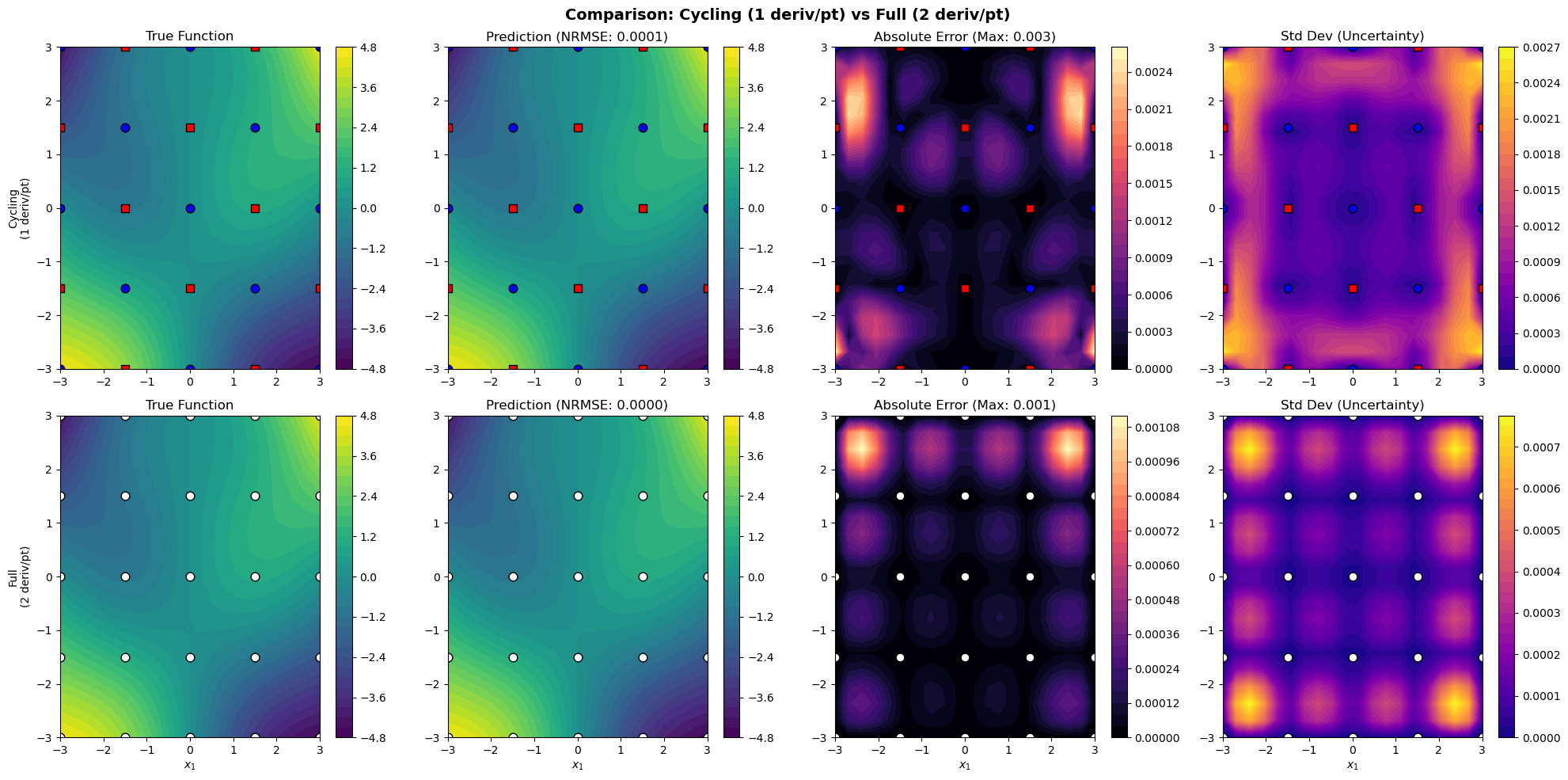
def plot_results_comparison(X_train, results_cycling, results_full, derivative_groups):
    """Compare cycling vs full derivative strategies."""
    fig, axes = plt.subplots(2, 4, figsize=(20, 10))

    colors = ['blue', 'red']
    markers = ['o', 's']

    # Row 1: Cycling strategy
    im0 = axes[0, 0].contourf(results_cycling["X1_grid"], results_cycling["X2_grid"],
                               results_cycling["y_true"], levels=30, cmap="viridis")
    for i, (group, color, marker) in enumerate(zip(derivative_groups, colors, markers)):
        axes[0, 0].scatter(X_train[group, 0], X_train[group, 1],
                           c=color, s=60, edgecolor='k', marker=marker)
    axes[0, 0].set_title("True Function")
    axes[0, 0].set_ylabel("Cycling\n(1 deriv/pt)")
    plt.colorbar(im0, ax=axes[0, 0])

    im1 = axes[0, 1].contourf(results_cycling["X1_grid"], results_cycling["X2_grid"],
                               results_cycling["y_pred"], levels=30, cmap="viridis")
    for i, (group, color, marker) in enumerate(zip(derivative_groups, colors, markers)):
        axes[0, 1].scatter(X_train[group, 0], X_train[group, 1],
                           c=color, s=60, edgecolor='k', marker=marker)
    axes[0, 1].set_title(f"Prediction (NRMSE: {results_cycling['nrmse']:.4f})")
    plt.colorbar(im1, ax=axes[0, 1])

    error_cycling = np.abs(results_cycling["y_true"] - results_cycling["y_pred"])
    im2 = axes[0, 2].contourf(results_cycling["X1_grid"], results_cycling["X2_grid"],
                               error_cycling, levels=30, cmap="magma")
    for i, (group, color, marker) in enumerate(zip(derivative_groups, colors, markers)):
        axes[0, 2].scatter(X_train[group, 0], X_train[group, 1],
                           c=color, s=60, edgecolor='k', marker=marker)
    axes[0, 2].set_title(f"Absolute Error (Max: {error_cycling.max():.3f})")
    plt.colorbar(im2, ax=axes[0, 2])

    im3 = axes[0, 3].contourf(results_cycling["X1_grid"], results_cycling["X2_grid"],
                               np.sqrt(results_cycling["y_var"]), levels=30, cmap="plasma")
    for i, (group, color, marker) in enumerate(zip(derivative_groups, colors, markers)):
        axes[0, 3].scatter(X_train[group, 0], X_train[group, 1],
                           c=color, s=60, edgecolor='k', marker=marker)
    axes[0, 3].set_title("Std Dev (Uncertainty)")
    plt.colorbar(im3, ax=axes[0, 3])

    # Row 2: Full derivatives
    im4 = axes[1, 0].contourf(results_full["X1_grid"], results_full["X2_grid"],
                               results_full["y_true"], levels=30, cmap="viridis")
    axes[1, 0].scatter(X_train[:, 0], X_train[:, 1], c='white', s=60, edgecolor='k')
    axes[1, 0].set_title("True Function")
    axes[1, 0].set_ylabel("Full\n(2 deriv/pt)")
    axes[1, 0].set_xlabel("$x_1$")
    plt.colorbar(im4, ax=axes[1, 0])

    im5 = axes[1, 1].contourf(results_full["X1_grid"], results_full["X2_grid"],
                               results_full["y_pred"], levels=30, cmap="viridis")
    axes[1, 1].scatter(X_train[:, 0], X_train[:, 1], c='white', s=60, edgecolor='k')
    axes[1, 1].set_title(f"Prediction (NRMSE: {results_full['nrmse']:.4f})")
    axes[1, 1].set_xlabel("$x_1$")
    plt.colorbar(im5, ax=axes[1, 1])

    error_full = np.abs(results_full["y_true"] - results_full["y_pred"])
    im6 = axes[1, 2].contourf(results_full["X1_grid"], results_full["X2_grid"],
                               error_full, levels=30, cmap="magma")
    axes[1, 2].scatter(X_train[:, 0], X_train[:, 1], c='white', s=60, edgecolor='k')
    axes[1, 2].set_title(f"Absolute Error (Max: {error_full.max():.3f})")
    axes[1, 2].set_xlabel("$x_1$")
    plt.colorbar(im6, ax=axes[1, 2])

    im7 = axes[1, 3].contourf(results_full["X1_grid"], results_full["X2_grid"],
                               np.sqrt(results_full["y_var"]), levels=30, cmap="plasma")
    axes[1, 3].scatter(X_train[:, 0], X_train[:, 1], c='white', s=60, edgecolor='k')
    axes[1, 3].set_title("Std Dev (Uncertainty)")
    axes[1, 3].set_xlabel("$x_1$")
    plt.colorbar(im7, ax=axes[1, 3])

    plt.suptitle("Comparison: Cycling (1 deriv/pt) vs Full (2 deriv/pt)",
                 fontsize=14, fontweight='bold')
    plt.tight_layout()
    plt.show()
Full Workflow#
Finally, we run the full workflow: generate training data, build the spatial chain, assign cycling derivatives, train both models, and compare results.
# Generate training points on grid
X_train = generate_grid_points(grid_size, lower_bounds, upper_bounds)
print(f"Grid: {grid_size}x{grid_size} = {len(X_train)} points")

# Evaluate function and derivatives
y_values, all_derivatives = evaluate_function_with_derivatives(X_train, n_bases, n_order)

# Build spatial chain and assign derivatives
chain = build_spatial_chain(X_train)
derivative_groups = assign_cycling_derivatives(chain, n_bases)
print(f"d/dx1 assigned to: {len(derivative_groups[0])} points")
print(f"d/dx2 assigned to: {len(derivative_groups[1])} points")

# Visualize the chain and derivative assignments
visualize_derivative_assignment(X_train, chain, derivative_groups)
Grid: 5x5 = 25 points
d/dx1 assigned to: 13 points
d/dx2 assigned to: 12 points
# Setup and train cycling model
print("Training CYCLING derivative model...")
y_train_cyc, der_indices_cyc, der_locs_cyc = setup_cycling_degp(
    X_train, y_values, all_derivatives, derivative_groups
)

total_obs_cyc = sum(y.shape[0] for y in y_train_cyc)
print(f"Total observations: {total_obs_cyc}")

gp_model_cyc, params_cyc = train_model(
    X_train, y_train_cyc, n_order, n_bases, der_indices_cyc, der_locs_cyc,
    normalize_data, kernel, kernel_type
)

verify_interpolation(gp_model_cyc, params_cyc, X_train, y_train_cyc,
                     der_locs_cyc, model_name="Cycling DEGP")
Training CYCLING derivative model...
Total observations: 50
New best for swarm at iteration 1: [ 0.02288031 -0.0687752   0.21318409 -4.11411214] -19.220847915131735
Best after iteration 1: [ 0.02288031 -0.0687752   0.21318409 -4.11411214] -19.220847915131735
Best after iteration 2: [ 0.02288031 -0.0687752   0.21318409 -4.11411214] -19.220847915131735
Best after iteration 3: [ 0.02288031 -0.0687752   0.21318409 -4.11411214] -19.220847915131735
Best after iteration 4: [ 0.02288031 -0.0687752   0.21318409 -4.11411214] -19.220847915131735
New best for swarm at iteration 5: [-0.0508107  -0.06230424  0.23172383 -5.94766267] -27.403638614778906
Best after iteration 5: [-0.0508107  -0.06230424  0.23172383 -5.94766267] -27.403638614778906
New best for swarm at iteration 6: [-0.12007599 -0.13490332  0.52319077 -3.94685222] -28.82615505953168
New best for swarm at iteration 6: [-0.04749708 -0.13959783  0.36342653 -5.72139088] -29.492138673259653
Best after iteration 6: [-0.04749708 -0.13959783  0.36342653 -5.72139088] -29.492138673259653
Best after iteration 7: [-0.04749708 -0.13959783  0.36342653 -5.72139088] -29.492138673259653
New best for swarm at iteration 8: [-0.11477947 -0.0852649   0.4309043  -5.7639108 ] -29.842012262794604
New best for swarm at iteration 8: [-0.10605811 -0.11692424  0.4164234  -6.04956514] -30.18611455643275
Best after iteration 8: [-0.10605811 -0.11692424  0.4164234  -6.04956514] -30.18611455643275
New best for swarm at iteration 9: [-0.08714331 -0.14513165  0.46615839 -5.75502978] -30.227039271971115
New best for swarm at iteration 9: [-0.09074826 -0.1297958   0.42268464 -6.57984822] -30.71903547471974
Best after iteration 9: [-0.09074826 -0.1297958   0.42268464 -6.57984822] -30.71903547471974
New best for swarm at iteration 10: [-0.09275524 -0.11647932  0.42083124 -4.92726718] -30.956679526958276
Gradient refinement improved
Best after iteration 10: [-0.08535655 -0.11865178  0.40388759 -4.92727385] -31.01601859258414
Best after iteration 11: [-0.08535655 -0.11865178  0.40388759 -4.92727385] -31.01601859258414
Best after iteration 12: [-0.08535655 -0.11865178  0.40388759 -4.92727385] -31.01601859258414
Best after iteration 13: [-0.08535655 -0.11865178  0.40388759 -4.92727385] -31.01601859258414
Best after iteration 14: [-0.08535655 -0.11865178  0.40388759 -4.92727385] -31.01601859258414
Best after iteration 15: [-0.08535655 -0.11865178  0.40388759 -4.92727385] -31.01601859258414
Best after iteration 16: [-0.08535655 -0.11865178  0.40388759 -4.92727385] -31.01601859258414
Best after iteration 17: [-0.08535655 -0.11865178  0.40388759 -4.92727385] -31.01601859258414
Best after iteration 18: [-0.08535655 -0.11865178  0.40388759 -4.92727385] -31.01601859258414
Best after iteration 19: [-0.08535655 -0.11865178  0.40388759 -4.92727385] -31.01601859258414
Gradient refinement improved
Best after iteration 20: [-0.0853565  -0.11865223  0.40388793 -4.92727433] -31.01601859340922
Best after iteration 21: [-0.0853565  -0.11865223  0.40388793 -4.92727433] -31.01601859340922
Best after iteration 22: [-0.0853565  -0.11865223  0.40388793 -4.92727433] -31.01601859340922
Best after iteration 23: [-0.0853565  -0.11865223  0.40388793 -4.92727433] -31.01601859340922
New best for swarm at iteration 24: [-0.08539533 -0.11867221  0.40415898 -4.98375729] -31.016032164859077
Best after iteration 24: [-0.08539533 -0.11867221  0.40415898 -4.98375729] -31.016032164859077
Best after iteration 25: [-0.08539533 -0.11867221  0.40415898 -4.98375729] -31.016032164859077
Best after iteration 26: [-0.08539533 -0.11867221  0.40415898 -4.98375729] -31.016032164859077
New best for swarm at iteration 27: [-0.08530748 -0.11866624  0.40380725 -4.97325889] -31.016033454541734
New best for swarm at iteration 27: [-0.08538567 -0.11861152  0.40398388 -5.03963891] -31.01604959891396
Best after iteration 27: [-0.08538567 -0.11861152  0.40398388 -5.03963891] -31.01604959891396
Best after iteration 28: [-0.08538567 -0.11861152  0.40398388 -5.03963891] -31.01604959891396
New best for swarm at iteration 29: [-0.08538199 -0.11864571  0.40401986 -5.03429086] -31.01605112150491
Best after iteration 29: [-0.08538199 -0.11864571  0.40401986 -5.03429086] -31.01605112150491
New best for swarm at iteration 30: [-0.08539519 -0.11861289  0.4040253  -5.05241157] -31.016051148794354
Stopping: Objective improvement < 1e-06

Interpolation Verification for Cycling DEGP
--------------------------------------------------
✓ Function values:  max_err = 4.81e-08
✓ ∂f/∂x₁ (n=13): max_err = 1.28e-08
✓ ∂f/∂x₂ (n=12): max_err = 1.21e-08
--------------------------------------------------
✓ ALL PASSED
True
# Setup and train full model
print("Training FULL derivative model...")
y_train_full, der_indices_full, der_locs_full = setup_full_degp(
    X_train, y_values, all_derivatives
)

total_obs_full = sum(y.shape[0] for y in y_train_full)
print(f"Total observations: {total_obs_full}")

gp_model_full, params_full = train_model(
    X_train, y_train_full, n_order, n_bases, der_indices_full, der_locs_full,
    normalize_data, kernel, kernel_type
)

verify_interpolation(gp_model_full, params_full, X_train, y_train_full,
                     der_locs_full, model_name="Full DEGP")
Training FULL derivative model...
Total observations: 75
New best for swarm at iteration 1: [ 0.02288031 -0.0687752   0.21318409 -4.11411214] -123.33388920120488
New best for swarm at iteration 1: [ -0.19066433   0.01431146   0.69548005 -13.82417601] -127.32396675945337
Best after iteration 1: [ -0.19066433   0.01431146   0.69548005 -13.82417601] -127.32396675945337
Best after iteration 2: [ -0.19066433   0.01431146   0.69548005 -13.82417601] -127.32396675945337
New best for swarm at iteration 3: [ -0.12690935  -0.11434224   0.75382203 -13.74870947] -146.44656907018174
Best after iteration 3: [ -0.12690935  -0.11434224   0.75382203 -13.74870947] -146.44656907018174
New best for swarm at iteration 4: [ -0.09769236  -0.03711586   0.30324901 -13.44328683] -147.25263358653768
Best after iteration 4: [ -0.09769236  -0.03711586   0.30324901 -13.44328683] -147.25263358653768
New best for swarm at iteration 5: [ -0.15501146  -0.13573274   0.85648248 -14.6955153 ] -152.39605580559663
New best for swarm at iteration 5: [ -0.13395107  -0.08959333   0.41961897 -14.27738139] -162.84982390976216
Best after iteration 5: [ -0.13395107  -0.08959333   0.41961897 -14.27738139] -162.84982390976216
Best after iteration 6: [ -0.13395107  -0.08959333   0.41961897 -14.27738139] -162.84982390976216
Best after iteration 7: [ -0.13395107  -0.08959333   0.41961897 -14.27738139] -162.84982390976216
New best for swarm at iteration 8: [ -0.16247549  -0.07478262   0.53312337 -14.10711649] -163.0197330484267
New best for swarm at iteration 8: [ -0.15821438  -0.09353034   0.50117283 -14.1276283 ] -164.5790431289176
Best after iteration 8: [ -0.15821438  -0.09353034   0.50117283 -14.1276283 ] -164.5790431289176
New best for swarm at iteration 9: [ -0.14626119  -0.0929051    0.50248213 -14.43815329] -164.60132934008067
New best for swarm at iteration 9: [ -0.15337719  -0.09807297   0.56059519 -14.02464198] -164.84032180938965
New best for swarm at iteration 9: [ -0.16188463  -0.10545082   0.56032827 -13.58037966] -165.08061230365269
Best after iteration 9: [ -0.16188463  -0.10545082   0.56032827 -13.58037966] -165.08061230365269
New best for swarm at iteration 10: [ -0.14811099  -0.11499776   0.5471476  -14.20583125] -165.16921389576174
New best for swarm at iteration 10: [ -0.15101411  -0.1002371    0.52931802 -14.40200458] -165.22345005939195
Gradient refinement improved
Best after iteration 10: [ -0.15377801  -0.10884412   0.56367311 -14.40200458] -165.4218699951649
Best after iteration 11: [ -0.15377801  -0.10884412   0.56367311 -14.40200458] -165.4218699951649
Best after iteration 12: [ -0.15377801  -0.10884412   0.56367311 -14.40200458] -165.4218699951649
Best after iteration 13: [ -0.15377801  -0.10884412   0.56367311 -14.40200458] -165.4218699951649
Best after iteration 14: [ -0.15377801  -0.10884412   0.56367311 -14.40200458] -165.4218699951649
Best after iteration 15: [ -0.15377801  -0.10884412   0.56367311 -14.40200458] -165.4218699951649
Best after iteration 16: [ -0.15377801  -0.10884412   0.56367311 -14.40200458] -165.4218699951649
Best after iteration 17: [ -0.15377801  -0.10884412   0.56367311 -14.40200458] -165.4218699951649
Best after iteration 18: [ -0.15377801  -0.10884412   0.56367311 -14.40200458] -165.4218699951649
Best after iteration 19: [ -0.15377801  -0.10884412   0.56367311 -14.40200458] -165.4218699951649
Best after iteration 20: [ -0.15377801  -0.10884412   0.56367311 -14.40200458] -165.4218699951649
Best after iteration 21: [ -0.15377801  -0.10884412   0.56367311 -14.40200458] -165.4218699951649
New best for swarm at iteration 22: [ -0.15383106  -0.10877669   0.56360527 -14.39177355] -165.42187181698955
Best after iteration 22: [ -0.15383106  -0.10877669   0.56360527 -14.39177355] -165.42187181698955
Best after iteration 23: [ -0.15383106  -0.10877669   0.56360527 -14.39177355] -165.42187181698955
Best after iteration 24: [ -0.15383106  -0.10877669   0.56360527 -14.39177355] -165.42187181698955
Best after iteration 25: [ -0.15383106  -0.10877669   0.56360527 -14.39177355] -165.42187181698955
Best after iteration 26: [ -0.15383106  -0.10877669   0.56360527 -14.39177355] -165.42187181698955
Best after iteration 27: [ -0.15383106  -0.10877669   0.56360527 -14.39177355] -165.42187181698955
Best after iteration 28: [ -0.15383106  -0.10877669   0.56360527 -14.39177355] -165.42187181698955
Best after iteration 29: [ -0.15383106  -0.10877669   0.56360527 -14.39177355] -165.42187181698955
New best for swarm at iteration 30: [ -0.15380979  -0.10881566   0.56371055 -14.39150475] -165.42187472124755
New best for swarm at iteration 30: [ -0.15377526  -0.10885564   0.56348412 -14.39402032] -165.42189876365677
Best after iteration 30: [ -0.15377526  -0.10885564   0.56348412 -14.39402032] -165.42189876365677
Stopping: maximum iterations reached --> 30

Interpolation Verification for Full DEGP
--------------------------------------------------
✓ Function values:  max_err = 1.86e-10
✓ ∂f/∂x₁ (n=25): max_err = 5.47e-11
✓ ∂f/∂x₂ (n=25): max_err = 6.24e-11
--------------------------------------------------
✓ ALL PASSED
True
# Evaluate both models
results_cyc = evaluate_on_grid(gp_model_cyc, params_cyc, lower_bounds,
                                upper_bounds, test_resolution)
results_full = evaluate_on_grid(gp_model_full, params_full, lower_bounds,
                                 upper_bounds, test_resolution)

print(f"Cycling NRMSE:  {results_cyc['nrmse']:.6f}")
print(f"Full NRMSE:     {results_full['nrmse']:.6f}")
print(f"Ratio:          {results_cyc['nrmse']/results_full['nrmse']:.3f}")

# Plot comparison
plot_results_comparison(X_train, results_cyc, results_full, derivative_groups)
Cycling NRMSE:  0.000074
Full NRMSE:     0.000025
Ratio:          2.946
Results Summary#
For a 5×5 grid (25 training points):
Strategy |
Function Values |
Derivative Obs |
Total Observations |
|---|---|---|---|
Cycling |
25 |
25 (1 per pt) |
50 |
Full |
25 |
50 (2 per pt) |
75 |
Observation reduction: 33%
# Print summary
print("=" * 60)
print("SUMMARY")
print("=" * 60)
print(f"Training points:              {len(X_train)}")
print(f"Dimensions:                   {n_bases}")
print()
print("Cycling strategy:")
print(f"  Function values:            {len(X_train)}")
print(f"  Derivative obs (1 per pt):  {len(X_train)}")
print(f"  Total observations:         {total_obs_cyc}")
print()
print("Full derivative strategy:")
print(f"  Function values:            {len(X_train)}")
print(f"  Derivative obs (2 per pt):  {len(X_train) * 2}")
print(f"  Total observations:         {total_obs_full}")
print()
print(f"Observation reduction:        {(1 - total_obs_cyc/total_obs_full)*100:.1f}%")
print(f"NRMSE ratio (cyc/full):       {results_cyc['nrmse']/results_full['nrmse']:.3f}")
print("=" * 60)
============================================================
SUMMARY
============================================================
Training points:              25
Dimensions:                   2

Cycling strategy:
  Function values:            25
  Derivative obs (1 per pt):  25
  Total observations:         50

Full derivative strategy:
  Function values:            25
  Derivative obs (2 per pt):  50
  Total observations:         75

Observation reduction:        33.3%
NRMSE ratio (cyc/full):       2.946
============================================================
Extension to Higher Dimensions#
For a d-dimensional problem, the cycling pattern extends naturally. Each point in the chain receives one derivative, cycling through all dimensions:
def assign_cycling_derivatives(chain, n_bases):
    """Cycle through all d dimensions along the chain."""
    derivative_groups = [[] for _ in range(n_bases)]

    for pos, pt_idx in enumerate(chain):
        group = pos % n_bases  # Cycles 0, 1, 2, ..., d-1, 0, 1, ...
        derivative_groups[group].append(pt_idx)

    return derivative_groups
For 4D, the pattern becomes:
Position 0, 4, 8, … → ∂f/∂x₁
Position 1, 5, 9, … → ∂f/∂x₂
Position 2, 6, 10, … → ∂f/∂x₃
Position 3, 7, 11, … → ∂f/∂x₄
This achieves a 75% reduction in derivative observations for 4D problems.
Key Takeaways#
Spatial correlation enables information sharing: The GP correlation structure allows derivative information to propagate between neighboring points.
Strategic placement matters: By cycling derivatives along a spatial chain, neighboring points have complementary information.
Trade-off: The cycling strategy reduces computational cost at the potential expense of some accuracy. The effectiveness depends on:
The length scale of the GP relative to point spacing
The smoothness of the underlying function
The spatial distribution of training points