High-Dimensional DEGP Tutorial: 4D Function Approximation with 2D Visualization#
In this tutorial, Derivative-Enhanced Gaussian Processes (DEGPs) are applied to a high-dimensional 4D function. We analyze the model’s performance through 2D slices of the input space, which allows us to visualize complex high-dimensional behavior in a comprehensible way.
This approach is useful for: - Understanding the behavior of high-dimensional nonlinear functions. - Leveraging derivative information to improve model accuracy. - Reducing computational cost by selectively including key derivatives.
Setup#
We begin by importing all necessary libraries, including pyoti for hypercomplex AD, full_degp for DEGP modeling, and standard scientific Python packages.
import numpy as np
import pyoti.sparse as oti
from jetgp.full_degp.degp import degp
import jetgp.utils as utils
import time
from matplotlib import pyplot as plt
from scipy.stats import qmc
from typing import List, Dict, Callable
Configuration#
We explicitly define all configuration parameters as simple variables. This includes the dimensionality of the input space, number of training points, kernel type, and other hyperparameters.
n_bases = 4
n_order = 2
num_training_pts = 25
slice_grid_resolution = 25
lower_bounds = [-5.0]*4
upper_bounds = [5.0]*4
normalize_data = True
kernel = "SE"
kernel_type = "anisotropic"
n_restarts = 15
swarm_size = 200
random_seed = 1354
np.random.seed(random_seed)
True Function#
The function we aim to model is the 4D Styblinski–Tang function. It is nonlinear and exhibits multiple minima, making it a challenging test case for high-dimensional regression methods.
def styblinski_tang_4d(X, alg=oti):
    """
    Styblinski–Tang function in 4D:
    f(x1,x2,x3,x4) = 0.5 * sum_{i=1}^4 (x_i^4 - 16 x_i^2 + 5 x_i)
    """
    x1, x2, x3, x4 = X[:,0], X[:,1], X[:,2], X[:,3]
    return 0.5 * (x1**4 - 16*x1**2 + 5*x1 +
                  x2**4 - 16*x2**2 + 5*x2 +
                  x3**4 - 16*x3**2 + 5*x3 +
                  x4**4 - 16*x4**2 + 5*x4)
Derivative Strategy#
DEGP allows us to include derivative observations to improve the predictive accuracy of the model. Here we select only the main first- and second-order derivatives, which significantly reduces computational cost while preserving accuracy.
def analyze_derivatives(n_bases, n_order):
    """Select main derivatives only (1st and 2nd order) and print counts."""
    complete_indices = utils.gen_OTI_indices(n_bases, n_order)
    complete_count = sum(len(group) for group in complete_indices)

    der_indices = [
        [[[i + 1, 1]] for i in range(n_bases)],  # 1st order
        [[[i + 1, 2]] for i in range(n_bases)]   # 2nd order
    ]
    selective_count = sum(len(group) for group in der_indices)

    print(f"Complete derivative set: {complete_count} terms (incl. cross-terms)")
    print(f"Selective strategy: {selective_count} terms (main derivatives only)")
    print(f"Reduction factor: {complete_count/selective_count:.1f}x")
    return der_indices
Training Data Generation#
We generate training data using Sobol sequences to efficiently cover the
high-dimensional space. For each training point, we evaluate the function as
well as the selected derivatives. We also construct the derivative_locations
list to specify that all derivatives are available at all training points.
def generate_training_data(n_bases, n_order, num_training_pts, lower_bounds, upper_bounds, der_indices):
    sampler = qmc.Sobol(d=n_bases, scramble=True, seed=42)
    sobol_sample = sampler.random_base2(m=int(np.ceil(np.log2(num_training_pts))))
    X_train = utils.scale_samples(sobol_sample, lower_bounds, upper_bounds)

    X_train_pert = oti.array(X_train)
    for i in range(n_bases):
        X_train_pert[:, i] += oti.e(i+1, order=n_order)

    y_train_hc = styblinski_tang_4d(X_train_pert)
    y_train_list = [y_train_hc.real]
    for group in der_indices:
        for sub_group in group:
            y_train_list.append(y_train_hc.get_deriv(sub_group))

    # Build derivative_locations: one entry per derivative, all at all points
    derivative_locations = []
    for i in range(len(der_indices)):
        for j in range(len(der_indices[i])):
            derivative_locations.append([k for k in range(len(X_train))])

    print(f"Total observations: {sum(d.shape[0] for d in y_train_list)}")
    print(f"Derivative locations: {len(derivative_locations)} entries, each with {len(X_train)} points")
    return X_train, y_train_list, derivative_locations
Model Training#
We initialize the DEGP model and optimize its hyperparameters using JADE
optimization. The model incorporates both function values and selected
derivatives, with derivative_locations specifying where each derivative
is available.
def train_model(X_train, y_train_list, n_order, n_bases, der_indices, derivative_locations, normalize_data, kernel, kernel_type, n_restarts, swarm_size):
    gp_model = degp(
        X_train, y_train_list, n_order, n_bases,
        der_indices,
        derivative_locations=derivative_locations,
        normalize=normalize_data,
        kernel=kernel, kernel_type=kernel_type
    )
    params = gp_model.optimize_hyperparameters(
        optimizer='pso',
        pop_size=250,
        n_generations=30,
        local_opt_every=30,
        debug=True
    )
    return gp_model, params
2D Slice Evaluation#
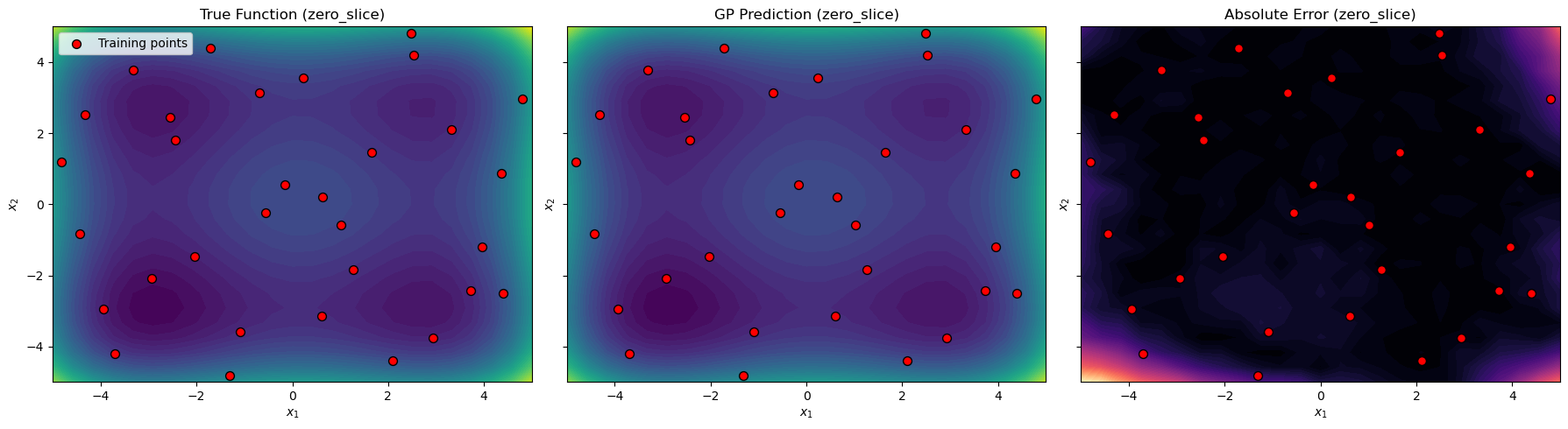
To visualize high-dimensional behavior, we evaluate the model on 2D slices of the 4D space. Here, the remaining two dimensions are fixed at zero, the domain center, or a random point.
def evaluate_slice(X_test_fixed_values):
    x_lin = np.linspace(lower_bounds[0], upper_bounds[0], slice_grid_resolution)
    y_lin = np.linspace(lower_bounds[1], upper_bounds[1], slice_grid_resolution)
    X1_grid, X2_grid = np.meshgrid(x_lin, y_lin)

    X_test = np.zeros((X1_grid.size, n_bases))
    X_test[:,0] = X1_grid.ravel()
    X_test[:,1] = X2_grid.ravel()
    for i, val in enumerate(X_test_fixed_values):
        X_test[:, i+2] = val

    y_pred, y_var = gp_model.predict(X_test, params, calc_cov=True)
    y_true = styblinski_tang_4d(X_test, alg=np)

    return {
        "X1_grid": X1_grid, "X2_grid": X2_grid,
        "y_true": y_true.reshape(X1_grid.shape),
        "y_pred": y_pred.reshape(X1_grid.shape),
        "nrmse": utils.nrmse(y_true, y_pred)
    }
Visualization#
We create contour plots of the true function, the GP prediction, and the absolute error for each 2D slice. Training points are overlaid to show their locations relative to the evaluation grid.
def plot_slices(X_train, slice_results, slice_name="zero_slice"):
    fig, axes = plt.subplots(1,3, figsize=(18,5), sharex=True, sharey=True)
    X_train_proj = X_train[:,:2]

    # True function
    axes[0].contourf(slice_results["X1_grid"], slice_results["X2_grid"], slice_results["y_true"], levels=50, cmap="viridis")
    axes[0].scatter(X_train_proj[:,0], X_train_proj[:,1], c="red", edgecolor="k", s=50, label="Training points")
    axes[0].set_title(f"True Function ({slice_name})")
    axes[0].legend()

    # GP prediction
    axes[1].contourf(slice_results["X1_grid"], slice_results["X2_grid"], slice_results["y_pred"], levels=50, cmap="viridis")
    axes[1].scatter(X_train_proj[:,0], X_train_proj[:,1], c="red", edgecolor="k", s=50)
    axes[1].set_title(f"GP Prediction ({slice_name})")

    # Absolute error
    error_grid = np.abs(slice_results["y_true"] - slice_results["y_pred"])
    axes[2].contourf(slice_results["X1_grid"], slice_results["X2_grid"], error_grid, levels=50, cmap="magma")
    axes[2].scatter(X_train_proj[:,0], X_train_proj[:,1], c="red", edgecolor="k", s=50)
    axes[2].set_title(f"Absolute Error ({slice_name})")

    for ax in axes:
        ax.set_xlabel("$x_1$")
        ax.set_ylabel("$x_2$")
    plt.tight_layout()
    plt.show()
Full Workflow#
Finally, we run the full workflow: analyze derivatives, generate training data (including derivative locations), train the model, evaluate a zero slice, and visualize the results.
der_indices = analyze_derivatives(n_bases, n_order)
X_train, y_train_list, derivative_locations = generate_training_data(
    n_bases, n_order, num_training_pts,
    lower_bounds, upper_bounds, der_indices
)

gp_model, params = train_model(
    X_train, y_train_list, n_order, n_bases,
    der_indices, derivative_locations,
    normalize_data, kernel, kernel_type,
    n_restarts, swarm_size
)

# Evaluate a 2D slice with the last two dimensions fixed at zero
slice_results = evaluate_slice(X_test_fixed_values=[0.0, 0.0])

# Visualize the slice
plot_slices(X_train, slice_results, slice_name="zero_slice")
Complete derivative set: 14 terms (incl. cross-terms)
Selective strategy: 8 terms (main derivatives only)
Reduction factor: 1.8x
Total observations: 288
Derivative locations: 8 entries, each with 32 points
New best for swarm at iteration 1: [ 0.02279516 0.09497524 0.20586795 0.13493861 0.69434126 -5.72591109] 874.2092347793057
Best after iteration 1: [ 0.02279516 0.09497524 0.20586795 0.13493861 0.69434126 -5.72591109] 874.2092347793057
Best after iteration 2: [ 0.02279516 0.09497524 0.20586795 0.13493861 0.69434126 -5.72591109] 874.2092347793057
New best for swarm at iteration 3: [-0.78718021 -1.12060992 -0.42553376 -0.92708697  3.9714838  -4.58824157] 621.8225655308001
Best after iteration 3: [-0.78718021 -1.12060992 -0.42553376 -0.92708697  3.9714838  -4.58824157] 621.8225655308001
New best for swarm at iteration 4: [-0.44893226 -0.53510706 -0.31977985 -0.60563432  2.43884712 -6.03379599] 540.5113667594405
Best after iteration 4: [-0.44893226 -0.53510706 -0.31977985 -0.60563432  2.43884712 -6.03379599] 540.5113667594405
New best for swarm at iteration 5: [-0.74299303 -0.45405842 -0.54662726 -0.60357143  2.85565382 -4.63862817] 469.6228924327094
Best after iteration 5: [-0.74299303 -0.45405842 -0.54662726 -0.60357143  2.85565382 -4.63862817] 469.6228924327094
New best for swarm at iteration 6: [-0.42355832 -0.58898204 -0.4120302  -0.50087364  2.15387536 -5.21676809] 457.96435566594073
New best for swarm at iteration 6: [-0.96324501 -0.63163179 -0.9774898  -0.7407199   3.70552312 -4.90592171] 337.4133683572934
Best after iteration 6: [-0.96324501 -0.63163179 -0.9774898  -0.7407199   3.70552312 -4.90592171] 337.4133683572934
New best for swarm at iteration 7: [-0.74712778 -0.7286189 -0.63433269 -0.7614569 3.20941561 -4.93808471] 208.63870628688335
Best after iteration 7: [-0.74712778 -0.7286189  -0.63433269 -0.7614569   3.20941561 -4.93808471] 208.63870628688335
New best for swarm at iteration 8: [-0.76127503 -0.89763207 -0.84012454 -0.83224439  3.44273492 -5.09216471] 71.96289025621263
Best after iteration 8: [-0.76127503 -0.89763207 -0.84012454 -0.83224439 3.44273492 -5.09216471] 71.96289025621263
Best after iteration 9: [-0.76127503 -0.89763207 -0.84012454 -0.83224439  3.44273492 -5.09216471] 71.96289025621263
New best for swarm at iteration 10: [-0.87489507 -0.89054703 -0.95130521 -0.85262932  3.66588903 -4.65925444] 5.375730188021237
New best for swarm at iteration 10: [-0.91950448 -0.9454822  -0.87768264 -0.88474765  3.61768481 -4.88295262] -7.2596349122064225
Best after iteration 10: [-0.91950448 -0.9454822  -0.87768264 -0.88474765  3.61768481 -4.88295262] -7.2596349122064225
New best for swarm at iteration 11: [-0.87439975 -0.93464544 -0.90182491 -0.88809714  3.66604648 -4.88837615] -30.896939096003678
Best after iteration 11: [-0.87439975 -0.93464544 -0.90182491 -0.88809714  3.66604648 -4.88837615] -30.896939096003678
New best for swarm at iteration 12: [-0.88311934 -0.96414665 -0.90999153 -0.9074942   3.73515762 -4.2163338 ] -34.54832198701541
New best for swarm at iteration 12: [-0.88732138 -0.89684952 -0.92591259 -0.90168838  3.70264262 -4.978146  ] -36.847928938178654
New best for swarm at iteration 12: [-0.90741169 -0.91571044 -0.89118043 -0.90647772  3.73516103 -4.95239336] -45.37493426394627
Best after iteration 12: [-0.90741169 -0.91571044 -0.89118043 -0.90647772  3.73516103 -4.95239336] -45.37493426394627
Best after iteration 13: [-0.90741169 -0.91571044 -0.89118043 -0.90647772  3.73516103 -4.95239336] -45.37493426394627
New best for swarm at iteration 14: [-0.90928997 -0.94042782 -0.8969147  -0.92457663  3.70177993 -4.99316033] -49.12852394948442
New best for swarm at iteration 14: [-0.93157407 -0.9147753  -0.92729344 -0.90555693  3.73143151 -5.05526334] -54.357772920728394
New best for swarm at iteration 14: [-0.94378214 -0.92942868 -0.9120638  -0.93732248  3.74284387 -4.97934418] -61.13446047264591
Best after iteration 14: [-0.94378214 -0.92942868 -0.9120638 -0.93732248 3.74284387 -4.97934418] -61.13446047264591
Best after iteration 15: [-0.94378214 -0.92942868 -0.9120638  -0.93732248  3.74284387 -4.97934418] -61.13446047264591
New best for swarm at iteration 16: [-0.90934032 -0.92665923 -0.91860942 -0.93464355  3.79210546 -4.69487153] -61.78430132985051
New best for swarm at iteration 16: [-0.93681474 -0.94399511 -0.90510422 -0.92798658  3.75190467 -4.98769735] -63.04497283161635
New best for swarm at iteration 16: [-0.92197    -0.93775438 -0.91091677 -0.9323509   3.76523934 -4.83373473] -65.35578377380205
New best for swarm at iteration 16: [-0.93062802 -0.93896959 -0.92036974 -0.91605009  3.81148785 -4.98282565] -66.74397846392714
Best after iteration 16: [-0.93062802 -0.93896959 -0.92036974 -0.91605009  3.81148785 -4.98282565] -66.74397846392714
Best after iteration 17: [-0.93062802 -0.93896959 -0.92036974 -0.91605009  3.81148785 -4.98282565] -66.74397846392714
New best for swarm at iteration 18: [-0.93840169 -0.93619636 -0.91383039 -0.92304528  3.7666893  -4.71271152] -67.95168065202404
New best for swarm at iteration 18: [-0.93683227 -0.93648874 -0.92518394 -0.92436342  3.80931326 -4.97964678] -71.02835912939395
Best after iteration 18: [-0.93683227 -0.93648874 -0.92518394 -0.92436342  3.80931326 -4.97964678] -71.02835912939395
Best after iteration 19: [-0.93683227 -0.93648874 -0.92518394 -0.92436342 3.80931326 -4.97964678] -71.02835912939395
Best after iteration 20: [-0.93683227 -0.93648874 -0.92518394 -0.92436342 3.80931326 -4.97964678] -71.02835912939395
Best after iteration 21: [-0.93683227 -0.93648874 -0.92518394 -0.92436342 3.80931326 -4.97964678] -71.02835912939395
Best after iteration 22: [-0.93683227 -0.93648874 -0.92518394 -0.92436342 3.80931326 -4.97964678] -71.02835912939395
Best after iteration 23: [-0.93683227 -0.93648874 -0.92518394 -0.92436342 3.80931326 -4.97964678] -71.02835912939395
Best after iteration 24: [-0.93683227 -0.93648874 -0.92518394 -0.92436342 3.80931326 -4.97964678] -71.02835912939395
New best for swarm at iteration 25: [-0.93659587 -0.93653128 -0.92491753 -0.92548683  3.80974184 -4.9795439 ] -71.6245199524854
Best after iteration 25: [-0.93659587 -0.93653128 -0.92491753 -0.92548683  3.80974184 -4.9795439 ] -71.6245199524854
Best after iteration 26: [-0.93659587 -0.93653128 -0.92491753 -0.92548683 3.80974184 -4.9795439 ] -71.6245199524854
Best after iteration 27: [-0.93659587 -0.93653128 -0.92491753 -0.92548683 3.80974184 -4.9795439 ] -71.6245199524854
Best after iteration 28: [-0.93659587 -0.93653128 -0.92491753 -0.92548683 3.80974184 -4.9795439 ] -71.6245199524854
Best after iteration 29: [-0.93659587 -0.93653128 -0.92491753 -0.92548683 3.80974184 -4.9795439 ] -71.6245199524854
Best after iteration 30: [-0.93659587 -0.93653128 -0.92491753 -0.92548683  3.80974184 -4.9795439 ] -71.6245199524854
Stopping: maximum iterations reached --> 30