1D Arbitrary Order Derivative-Enhanced Gaussian Process Numerical Example#
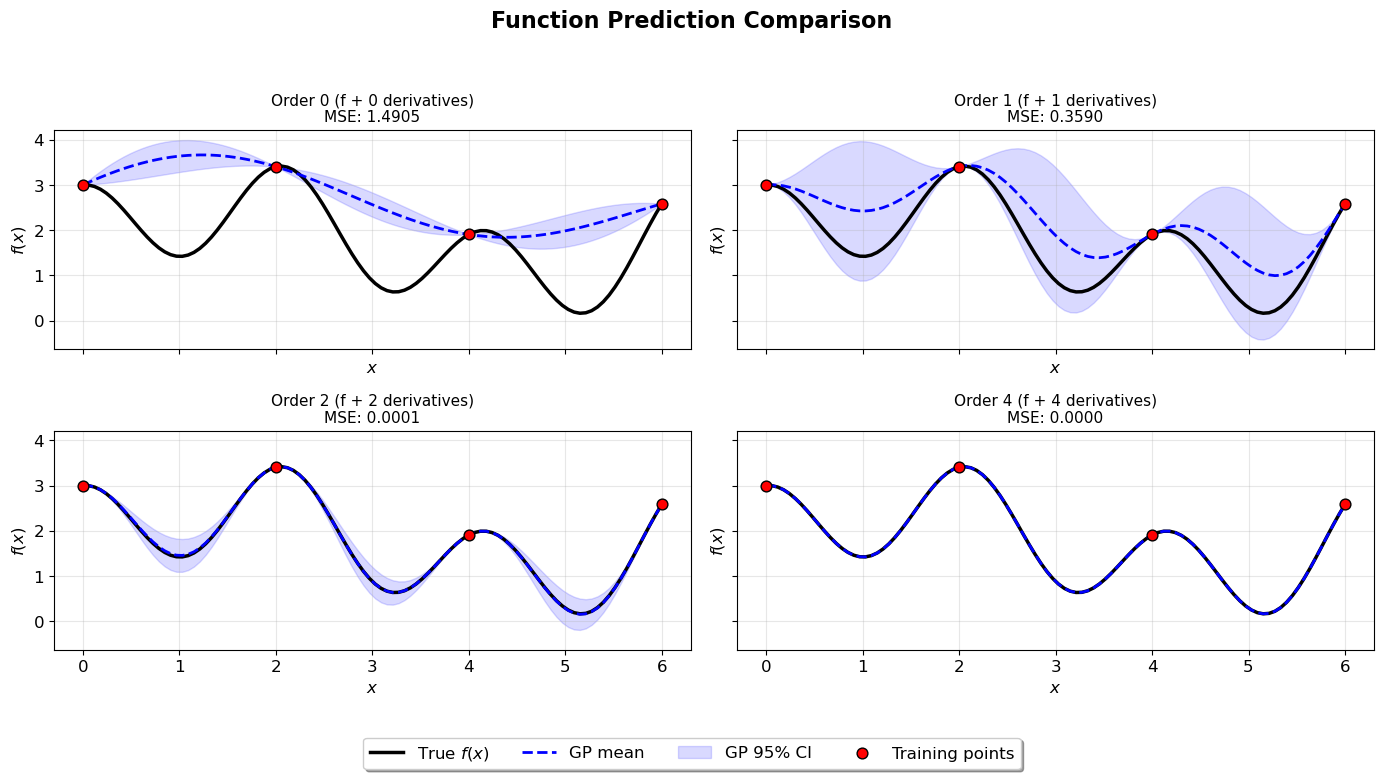
This example demonstrates Arbitrary Order Derivative-Enhanced Gaussian Processes (DEGPs) for modeling a 1D function. We train DEGP models with derivative orders 0, 1, 2, and 4, and visualize predictions and derivative approximations.
Setup#
Import necessary packages and set plotting parameters.
import numpy as np
import matplotlib.pyplot as plt
import pyoti.sparse as oti
from jetgp.full_degp.degp import degp
import jetgp.utils as utils
import time

plt.rcParams.update({'font.size': 12})
Target Function#
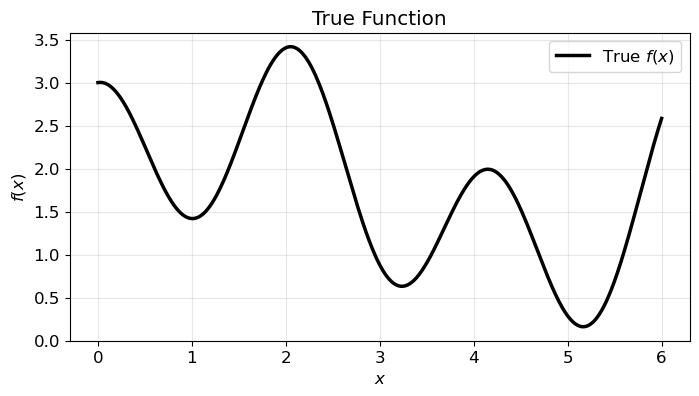
We model the following 1D function:
over the domain \(x \in [0, 6]\). The following plot shows the function.
# Domain
lb_x, ub_x = 0, 6.0
num_plot_pts = 500
X_plot = np.linspace(lb_x, ub_x, num_plot_pts).reshape(-1,1)

# Define function
def true_function(X, alg=oti):
    x = X[:, 0]
    return alg.exp(-x) + alg.sin(x) + alg.cos(3 * x) + 0.2 * x + 1.0

# Compute function values
y_plot = true_function(X_plot, alg=np)

# Plot
plt.figure(figsize=(8,4))
plt.plot(X_plot, y_plot, 'k-', lw=2.5, label='True $f(x)$')
plt.xlabel('$x$')
plt.ylabel('$f(x)$')
plt.title('True Function')
plt.grid(True, alpha=0.3)
plt.legend()
plt.show()
Define Parameters#
num_training_pts = 4
num_test_pts = 100
orders_to_test = [0, 1, 2, 4]

kernel = "SE"
kernel_type = "anisotropic"
n_restarts = 15
swarm_size = 150
normalize_data = False
Parameter Explanation#
The following parameters control the DEGP training and evaluation:
`lb_x` and `ub_x`: The lower and upper bounds of the 1D input domain.
`num_training_pts`: Number of training points used to fit the GP. These points are equally spaced in the domain.
`num_test_pts`: Number of points in the test grid for evaluation and plotting.
`orders_to_test`: List of derivative orders to include when training the GP. An order n DEGP uses derivatives up to n-th order at each training point.
`kernel` and `kernel_type`: Specify the covariance kernel and whether it is isotropic or anisotropic.
`n_restarts` and `swarm_size`: Hyperparameter optimization settings controlling the number of optimizer restarts and swarm size for PSO.
`normalize_data`: If True, training data and derivatives are normalized before fitting the GP.
Increasing the derivative order increases the number of observations per training point, improving the model’s ability to capture local curvature but also increasing computational cost.
Train and Evaluate DEGP Models#
For each derivative order, we train a Derivative-Enhanced Gaussian Process (DEGP) model. The workflow is as follows:
Derivative Index Generation: Using utils.gen_OTI_indices, we generate der_indices which enumerate the multi-index sets corresponding to all partial derivatives up to the specified order. In 1D, this simply corresponds to derivatives of order 1, 2, …, up to the requested maximum order.
Hypercomplex Automatic Differentiation: The oti.array structure allows us to represent training inputs in a hypercomplex algebra. By adding oti.e(1, order=order) to the input array, we tag each point with hypercomplex elements enabling automatic differentiation. Evaluating true_function on this hypercomplex array yields both the function value and all requested derivatives via the get_deriv method.
Training Data Construction: - y_train_hc.real contains the standard function values at each training point. - y_train_hc.get_deriv(der_indices[i][j]) extracts the value of each derivative according to the multi-index sets generated. - The full list y_train_list is then supplied to the DEGP constructor.
DEGP Model Initialization: The degp constructor takes: - X_train: the training input points. - y_train_list: a list of function and derivative observations. - order: maximum derivative order. - der_indices: the derivative multi-indices. - Kernel and normalization options (kernel, kernel_type, normalize).
This fully specifies the DEGP problem, enabling the model to condition on both function and derivative observations.
Hyperparameter Optimization: The model hyperparameters are optimized using a combination of restarts (n_restart_optimizer) and a particle swarm (swarm_size) for global optimization.
Prediction: Once trained, gp.predict computes: - The posterior mean for the function (and derivatives if requested) - Variance estimates for uncertainty quantification - Only the function predictions are used for computing MSE in this tutorial, though derivative predictions are available for analysis.
Below is the function that implements this procedure:
def train_and_evaluate_degps(X_train, X_test, true_function, order):
    print(f"Processing Order {order}...")
    start_time = time.time()

    # Generate Training Data with Derivatives
    der_indices = utils.gen_OTI_indices(1, order)
    X_train_pert = oti.array(X_train) + oti.e(1, order=order)
    derivative_locations = []
    for i in range(len(der_indices)):
        for j in range(len(der_indices[i])):
            derivative_locations.append([i for i in range(len(X_train ))])
    y_train_hc = true_function(X_train_pert)

    y_train_list = [y_train_hc.real]
    for i in range(len(der_indices)):
        for j in range(len(der_indices[i])):
            derivative = y_train_hc.get_deriv(der_indices[i][j]).reshape(-1, 1)
            y_train_list.append(derivative)

    # Initialize and train DEGP model
    gp = degp(
        X_train, y_train_list, order, n_bases=1, der_indices=der_indices,derivative_locations = derivative_locations,
        normalize=normalize_data, kernel=kernel, kernel_type=kernel_type
    )

    params =gp.optimize_hyperparameters(
    optimizer='jade',
    pop_size = 100,
    n_generations = 15,
    local_opt_every = None,
    debug = True
    )

    # Predict function and derivatives
    y_pred_full, y_var_full = gp.predict(X_test, params, calc_cov=True, return_deriv=False)

    # Compute MSE for function predictions only
    y_pred_func = y_pred_full[:num_test_pts]
    y_true_flat = true_function(X_test, alg=np).ravel()
    mse = np.mean((y_pred_func.ravel() - y_true_flat)**2)

    print(f"  MSE: {mse:.6f}, Time: {time.time() - start_time:.2f}s")
    return {
        'y_pred_full': y_pred_full,
        'y_var_full': y_var_full,
        'mse': mse,
        'time': time.time() - start_time,
        'n_observations': sum(len(y) for y in y_train_list)
    }
Run DEGP Models for All Orders#
X_train = np.linspace(lb_x, ub_x, num_training_pts).reshape(-1, 1)
X_test = np.linspace(lb_x, ub_x, num_test_pts).reshape(-1, 1)

results = {}
for order in orders_to_test:
    results[order] = train_and_evaluate_degps(X_train, X_test, true_function, order)
Processing Order 0...
Gen 1: best f=8.555515100592274
Gen 2: best f=8.555515100592274
Gen 3: best f=8.555515100592274
Gen 4: best f=8.555515100592274
Gen 5: best f=8.199102832031281
Gen 6: best f=8.199102832031281
Gen 7: best f=8.199102832031281
Gen 8: best f=8.108279627133218
Gen 9: best f=8.108279627133218
Gen 10: best f=8.060756341668167
Gen 11: best f=8.060756341668167
Gen 12: best f=8.060756341668167
Gen 13: best f=8.053839290000669
Gen 14: best f=8.053839290000669
Gen 15: best f=8.053556753787092
  MSE: 1.490532, Time: 0.52s
Processing Order 1...
Gen 1: best f=23.265770371412046
Gen 2: best f=23.265770371412046
Gen 3: best f=18.864341106107766
Gen 4: best f=18.864341106107766
Gen 5: best f=18.864341106107766
Gen 6: best f=18.864341106107766
Gen 7: best f=18.705168369064342
Gen 8: best f=18.705168369064342
Gen 9: best f=18.705168369064342
Gen 10: best f=18.652116149281426
Gen 11: best f=18.652116149281426
Gen 12: best f=18.641173522932522
Gen 13: best f=18.641173522932522
Gen 14: best f=18.641173522932522
Gen 15: best f=18.641173522932522
  MSE: 0.405550, Time: 0.45s
Processing Order 2...
Gen 1: best f=30.7077866284139
Gen 2: best f=30.653381152266228
Gen 3: best f=30.653381152266228
Gen 4: best f=30.653381152266228
Gen 5: best f=29.668770136712908
Gen 6: best f=29.668770136712908
Gen 7: best f=29.238581681543018
Gen 8: best f=29.238581681543018
Gen 9: best f=29.238581681543018
Gen 10: best f=29.238581681543018
Gen 11: best f=29.238581681543018
Gen 12: best f=29.02767446037833
Gen 13: best f=28.958424754644412
Gen 14: best f=28.958424754644412
Gen 15: best f=28.75714337903282
  MSE: 0.000176, Time: 0.44s
Processing Order 4...
Gen 1: best f=49.397317422741395
Gen 2: best f=41.45380858655557
Gen 3: best f=41.45380858655557
Gen 4: best f=40.004110625540164
Gen 5: best f=40.004110625540164
Gen 6: best f=35.19297036911484
Gen 7: best f=33.26289537337141
Gen 8: best f=33.26289537337141
Gen 9: best f=33.26289537337141
Gen 10: best f=33.134821652944694
Gen 11: best f=33.134821652944694
Gen 12: best f=33.134821652944694
Gen 13: best f=33.134821652944694
Gen 14: best f=33.134821652944694
Gen 15: best f=33.09093176452107
  MSE: 0.000000, Time: 0.46s
Display Summary#
print("RESULTS SUMMARY")
print("="*60)
print(f"{'Order':<8}{'MSE':<12}{'Time (s)':<10}{'Observations'}")
print("-"*60)
for order, r in results.items():
    print(f"{order:<8}{r['mse']:<12.6f}{r['time']:<10.2f}{r['n_observations']}")
RESULTS SUMMARY
============================================================
Order   MSE         Time (s)  Observations
------------------------------------------------------------
0       1.490532    0.52      4
1       0.405550    0.45      8
2       0.000176    0.44      12
4       0.000000    0.46      20
Visualize Function Predictions#
import math

n_orders = len(orders_to_test)
n_cols = 2
n_rows = math.ceil(n_orders / n_cols)
fig, axs = plt.subplots(n_rows, n_cols, figsize=(7*n_cols, 4*n_rows), sharex=True, sharey=True)
axs = axs.flatten()
y_true = true_function(X_test, alg=np)
y_train_func = true_function(X_train, alg=np)

for i, order in enumerate(orders_to_test):
    ax = axs[i]
    r = results[order]
    y_pred = r['y_pred_full'][:num_test_pts]
    y_var = r['y_var_full'][:num_test_pts]

    ax.plot(X_test, y_true, 'k-', lw=2.5, label="True $f(x)$")
    ax.plot(X_test, y_pred.flatten(), 'b--', lw=2, label="GP mean")
    ax.fill_between(
        X_test.ravel(),
        y_pred.ravel() - 2*np.sqrt(y_var.ravel()),
        y_pred.ravel() + 2*np.sqrt(y_var.ravel()),
        color='blue', alpha=0.15, label='GP 95% CI'
    )
    ax.scatter(X_train, y_train_func, c='red', s=60, zorder=5,
               edgecolors='black', linewidth=1, label="Training points")

    # Title with order and number of derivatives
    num_derivatives = sum(len(group) for group in utils.gen_OTI_indices(1, order))
    ax.set_title(f"Order {order} (f + {num_derivatives} derivatives)\nMSE: {r['mse']:.4f}", fontsize=11)
    ax.set(xlabel="$x$", ylabel="$f(x)$")
    ax.grid(True, alpha=0.3)

# Hide any extra subplots if n_orders < n_rows*n_cols
for j in range(i+1, n_rows*n_cols):
    fig.delaxes(axs[j])

fig.suptitle('Function Prediction Comparison', fontsize=16, fontweight='bold', y=0.98)
handles, labels = axs[0].get_legend_handles_labels()
fig.legend(handles, labels, loc='lower center', bbox_to_anchor=(0.5, 0.02), ncol=len(handles), frameon=True, fancybox=True, shadow=True)
plt.tight_layout(rect=[0, 0.1, 1, 0.95])
plt.show()